
Lead, or Expect Compliance. Not Both.
Based on an excerpt of Seth Godin's new book, The Knot. Lead, or Expect Compliance. Not Both. Are leading and expecting complice incompatible?
 Shawn P. Walsh, MBA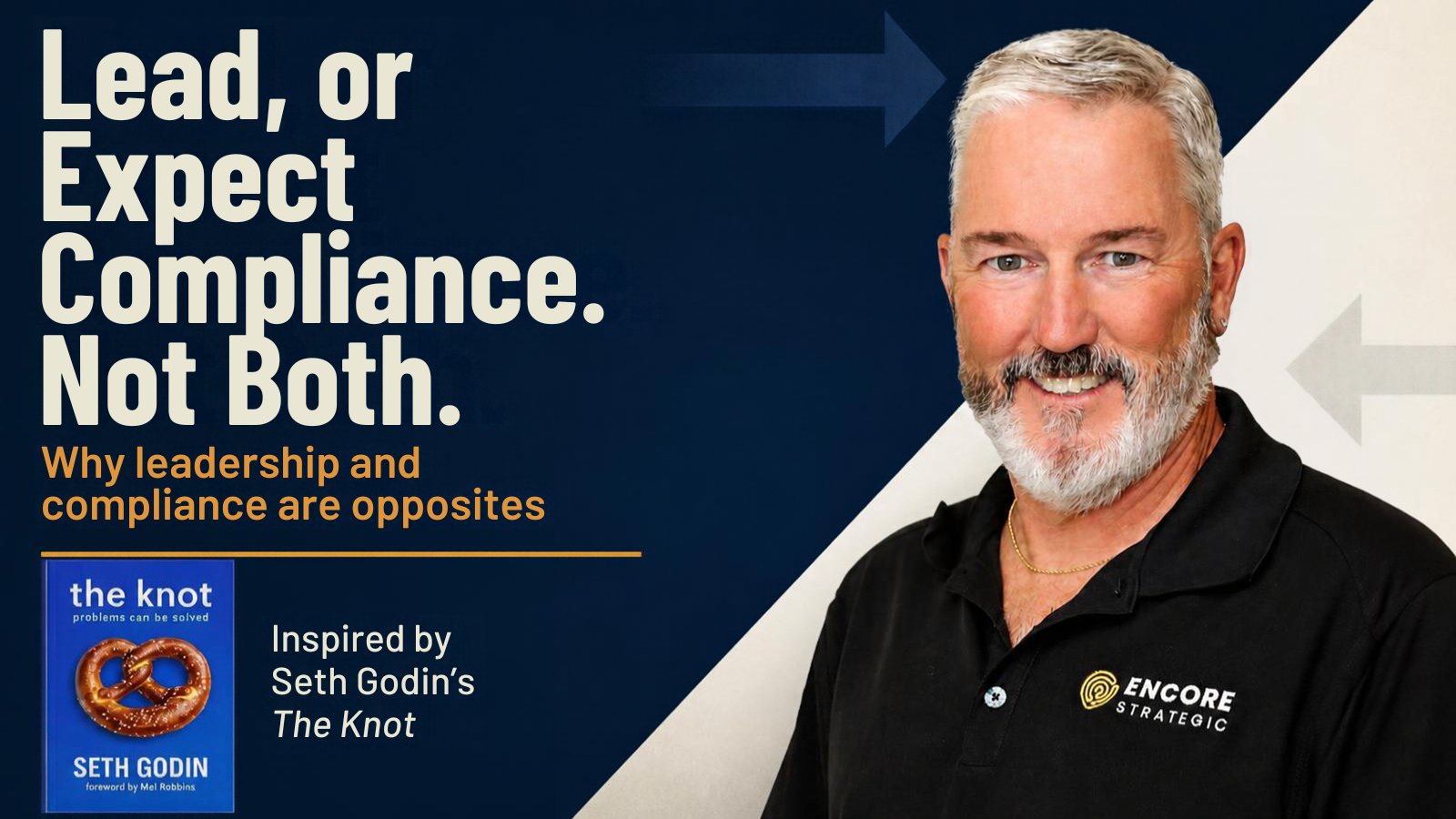
This week I had the honor of being invited to join Seth Godin and a small group of amazing people in NYC for the launch of Seth's new book, The Knot. I've been a fan of Seth's work for many years. His writing makes me think differently, opens me up to new ideas, and often moves me out of the box when I find myself stuck in my own head. I'm only halfway through this one, and it's already hitting a special chord for me.
I'm sure there will be several more ah-ha moments before I finish it, but this particular one stopped me in my tracks. In some ways it's obvious. But I've worked with so many clients who struggle with it that I wanted to share my thoughts.
The entanglement
The Knot describes the concept of entanglement, part of which is competing pairs of things you cannot hold at the same time. "Stay and go, ship and hide, lead and expect compliance."
That sentence right there made me stop. I paused, let it sink in, then read it again. Lead and expect compliance. Are those incompatible, diametrically opposed ideas? Yes. Unfortunately, many business owners would say "lead" and "expect compliance" belong together. They don't. And the confusion between them is one of the most common reasons good operators turn into poor leaders.
The distinction
Leading only works if people can choose not to follow. You offer a direction, people decide whether it's worth going, and they bring their judgment, energy and discretionary effort with them, or they don't. You cannot order someone to join you on that part of the journey.
Compliance takes the choice away. It rests on authority and consequences. It sounds like "do this, or else." That can be completely reasonable under certain circumstances; there is a time and a place for it. But the moment you expect compliance, you have stopped leading and started commanding.
You can have both. You just cannot have both in the same moment, on the same ask. If the message is "follow me, but you have no choice," your people only hear the second half of what you say.
Why even smart owners miss it
Position is mistaken for leadership. Being the one who hands out consequences can feel like leading. It's really authority.
In the chain of command, obedience is by design. But the sergeant people would follow through a door usually isn't the same sergeant who orders others through it. That privilege isn't earned by sewing stripes on your sleeve. The rank got compliance; the person earned the following.
Compliance is easy to measure. Tickets closed, boxes checked. Commitment is harder to see… until it's gone.
Technicians who became owners tend to fall into the trap of "just do it the way I showed you." That works on servers. It does not work on people.
What compliance-only leadership costs you
With compliance, here's what you get:
Minimum effort. People do what is required and stop there.
No bad news. People who comply don't volunteer problems, so you learn about them late.
Malicious compliance. "I did exactly what you told me" becomes a weapon.
You become the bottleneck. When people stop using their own judgment, every decision comes back to you.
And that last one is an exit problem, not just a management problem. A business built on compliance cannot run without its owner and a business that cannot run without its owner isn't worth much to a buyer.
The real poison is pretending
The worst damage isn't even done by the CEO who demands compliance. It's done by the one who dresses compliance up as leadership. "I'd love your input" when the decision is already made. "It's your call," followed by "why did you do it that way?" Do that a few times and people stop believing the invitation, even when it's real.
Be honest about which one you're doing
Compliance — manage it. Security policy, SLAs, billing accuracy, PSA and ticket hygiene, licensing, documentation standards. It sounds like: "This one is non-negotiable, and here is why." What you get: consistency.
Leadership — lead it. Direction, service culture, standards of excellence, how we treat clients, innovation, who we hire. It sounds like: "Here is where we're going. Help me figure out how." What you get: ownership and discretionary effort.
Both are legitimate. Mixing them up is the problem.
It's all in the ask
I know this is a problem because I'm a recovering bad boss. I was this problem.
I came from a police and military background when I started my business, and I'm a firm believer in Lombardi Time: early is on time, on time is late. I would get completely frustrated with team members who didn't live by it. I'd stand by the door tapping my watch as people came in at 8:09. But looking back, I had never actually communicated any of it. I just expected it. In my head it sounded like: "Why can't they see that this is important?" "How many times do I have to tell them?"
After that and after a lot of other problems I later realized were a crisis of leadership on my part I learned to communicate differently. In a way that asked people to join us.
When we interviewed new team members, we explained that timeliness was critical. Not because the boss was an unreasonable lunatic (which I may have been), but because our clients expected us to be there for them, and being there was our purpose as a team. We explained that we had contracts with our clients, and that they paid us to fulfill the promises in those contracts. The contract said we would be there to answer their calls at 8:00. Not walking in the door at 8:10, getting a coffee, sitting down at your desk and then answering the call but at your computer, logged in, ready to solve the client's problem at 8:00.
And if you're the kind of person who likes to solve clients' problems and stand by your commitments, then you're in the right place because people like us do things like that. (Another concept I learned from Seth a long time ago.)
The expectation was clear: if this resonates with you, come join us. If it doesn't, that's OK — this just isn't your place.
That's hiring based on core values. Once we started doing it, I never stood by the door looking at my watch again. In fact, years later we had a new employee strolling in late, and before I could say anything he was intercepted by a teammate who told him, "We don't do that here. Our clients need us on time to solve their problems. They're counting on us. Please be on time tomorrow."
That's when I knew I was no longer demanding compliance. I was leading.
Three questions to sit with
If your team could ignore you with no consequences, what would they still do because of you? That answer is the part you're actually leading.
Where have you asked for commitment while offering only compliance — and then been frustrated by the result?
Which of your "non-negotiables" have you never actually named as non-negotiable?
Listen for these in your own voice
"I shouldn't have to tell them twice." • "They just need to do what I say." • "Nobody around here takes ownership."
Each one usually means the same thing: you expected compliance, and you're upset you didn't get commitment.
Compliance is what you get when people have to. Leadership is what you get when they don't have to — and do it anyway.
Shawn P. Walsh, MBA
Encore Strategic coaches, guides, and mentors MSP founders through operational maturity, margin expansion, and lucrative exit transactions.
Wondering What Your MSP Would Command on the Market?
Discover your EBITDA multiple range, client concentration index, and key-person dependency risks with an Encore Strategic valuation assessment.