
Dave Cava on Why Operational Maturity, Not AI, Determines MSP Survival
Check out former Encore Strategic Partner and CEO of PeopleSharp on MSP Radio's The Business of Tech. Dave shares his observations on AI in the MSP marketplace and what many MSP's are getting wrong.
 Shawn P. Walsh, MBA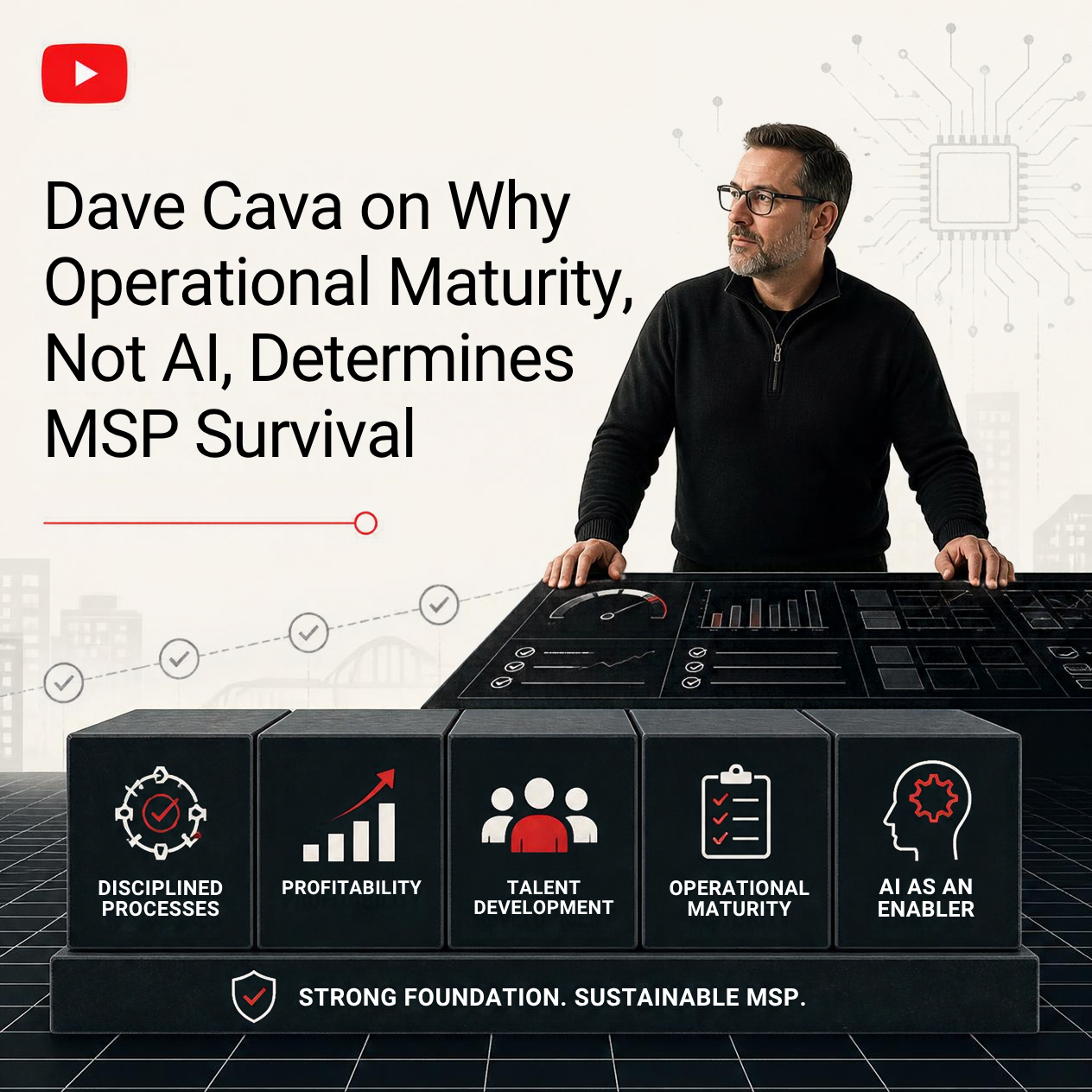
Check out former Encore Strategic Partner and CEO of PeopleSharp on MSP Radio's The Business of Tech.
Dave shares his observations on AI in the MSP marketplace and what many MSP's are getting wrong.
Dave Cava's central point is hard to dispute: AI speeds up whatever business it's put into. An MSP with weak processes, loose pricing and slow hiring will realize its problems faster. Encore Strategic agrees with that diagnosis. So what should an MSP owner should do about it?
Process before technology, But waiting is not the answer.
Dave warns that adopting AI quickly without process discipline creates more risk than opportunity. That's true, but some owners will take it as permission to sit still. The real question is sequencing, not speed. An MSP that spends two years "getting its house in order" before touching AI will fall behind competitors who did both at once. Our advice is to fix the processes that AI will touch first, such as ticket triage, documentation and dispatch, and to adopt AI in those areas as each one matures.
AI is a margin question as much as a technology question.
The numbers Dave cites, with over half of MSPs under 5% profit and roughly a quarter losing money, are usually read as a cost problem. In our experience they're just as often a pricing and client-selection problem. That matters because AI lowers the cost of delivering service. An MSP that prices on cost-plus or matches competitors will pass those savings to clients within a contract cycle or two. An MSP that prices on value keeps them. Whether AI raises your margin or quietly erodes it depends on your pricing model, not the tool.
Scale matters less than focus.
Dave is right that larger, well-funded MSPs will adopt AI faster. We don't think smaller firms should try to match them. Big MSPs have more money, but they also carry more complexity and more clients who don't fit. A smaller MSP that narrows its client base to its best-fit clients (the Pumpkin Plan approach) can deliver deeper, more tailored service than a larger competitor. Some of those unprofitable MSPs aren't too small. They serve too many of the wrong clients.
The talent factory has a built-in contradiction.
This is the part of the discussion that deserves the most attention. Dave argues that MSPs need to become "talent factories" that develop technicians internally. He also notes that AI is shrinking the L1 roles where that development has always started. Both can be true, but they pull against each other. If automation removes the entry-level work, where do future L2 and L3 technicians learn? Owners chasing revenue-per-employee targets will be tempted to cut junior roles first. We push clients to design the apprenticeship path on purpose: keep a smaller, intentional junior bench whose work mixes supervised automation with real client exposure. If you don't, you'll have to buy senior talent in a tight market later.
Slow hiring is usually a leadership problem.
PeopleSharp's figure of a 30-day gap between presenting a candidate and an accepted offer is striking, and Dave puts the blame on MSP-side process. From inside the business, the delay usually comes from further up: no defined role scorecard, an owner who has to approve every step, or no agreement on what "qualified" means. Tightening the process helps, but it treats the symptom. The fix is making hiring a delegated, repeatable process instead of an owner decision.
What makes it enough.
Dave closes by calling these steps necessary. What makes them sufficient is a clear picture of where the business is headed. Owners who build for eventual exit, with recurring revenue, documented processes, a leadership team that doesn't depend on them and margins that hold up under scrutiny, end up building the kind of MSP that can absorb AI rather than be threatened by it. The same discipline that protects you through this shift also makes the business worth more when you sell.
The bottom line: Dave and Encore agree on the diagnosis. Pricing, client selection, talent design and leadership decide whether AI becomes a margin gain or a margin loss, and owners should be working on those now.
Shawn P. Walsh, MBA
Encore Strategic coaches, guides, and mentors MSP founders through operational maturity, margin expansion, and lucrative exit transactions.
Wondering What Your MSP Would Command on the Market?
Discover your EBITDA multiple range, client concentration index, and key-person dependency risks with an Encore Strategic valuation assessment.